Showing posts with label recycled wool rug. Show all posts

Monday, December 16, 2013

Twined Rugs From Recycled Clothing

recycled clothes, twined rugI've seen numerous websites for twined rugs where people purchase discounted yardage. I really want to promote re-using cloth that is bound for incineration. It is easy to buy a few meters of the colors you want to make the perfect rug but much more challenging and rewarding to figure out what to do with grandpa's old suit and the children's curtains!

Most of the carpets are about 100 cm x 50 or 60 cm. Doormat size.
recycled silk twined rug
Recycled silk men's kimonos, poly and cotton mix twined rug.
A lady gave me kimono panels, the printed pattern but it wasn't enough to make anything so I added a purple yukata and some red to pick up the colors in the print. It is a bit skinny: 60 x100 cm.

Detail of same direction weave to create pattern.
Detail of pretty kimono prints. Silk and cotton; cotton warp.

recycled clothes, twined rug
Recycled summer kimono fabric and cotton doormat. The edges got straighter after I stretched it out a bit.
recycled wool clothes twined rug
Recycled woolens, twined rug. I used every warp for thinner pieces and every other warp for heavier wool strips so there is some variation in the design.


rug twining detail
Silk and poly twined rug detail. Recycled kimono linings and women's blouses.

Twined rug from recycled clothes.

recycled wool
Twined rug from recycled
wool suits and flannel shirts.

recycled cloth
First twined rug.
 Recycled sofa cover and kilt.

recycled cloth and silk
Large cotton twined rug.
All silk altar mat from recycled kimonos.

recycled cloth
Twined kitchen mat from scraps of cotton.
Recycled shirts, summer dresses, blouses.

recycled cloth
Large twined rug from cotton remnants.
Long (300cm x 50cm) twined carpet from family yukatas. Not my favorite colors but it is like a memory album of this family's old clothes!
Detail from twined rug made from old sheets and scraps from various clothes, shirts, yukata, aprons.


Colorful cotton bed sheets from the recycling bin and an old striped office shirt are re-purposed as a washable colorful bath mat. (100 x 65 cm)


Hooked Rugs

Supplies: 

  • Monk's cloth, rug warp or rug linen or similarly loosely woven fabric to serve as a backing; 
  • rug hook; 
  • felted wool strips or other fabric that does not readily fray;
  • frame to hold the fabric (like a large embroidery hoop or quilter's frame)
  • scissors, rotary cutter, straight edge
There are numerous outlets that sell precut wool strips. There are also cutters designed for cutting consistent width strips.
It is all more expense that I care to invest in. 
I made a simple frame of scraps with adhesive velcro to secure my fabric and cut strips of wool and silk using the rotary scissors. I got started by watching Gene Shephard's video:  How to Hook Rugs

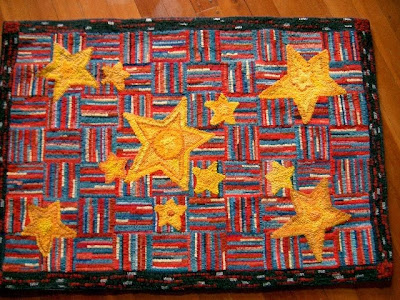
My first carpet is all wool, mostly felted wool that was purchased as well as a re-purposed shawl from Nepal and remnants of a Scottish kilt.
rug hooking
Hooked rug, wool

Introduction

There are many kinds of homemade rug methods. I've  found that twined rugs and toothbrush rugs are the best for using recycled clothes.

Re-purposing old kimonos, summer yukatas, favorite blankets or curtains into woven floor coverings allows us to utilize otherwise unusable items one more time before they become rubbish. When items are stained, torn or damaged or too outdated to be worn again, they are suitable for ripping into strips and twisting into rugs!


  1. The first method I explored was rug hooking. I enjoyed this and tried to use some recyclable material but found that the backing cloth (rug warp or Monk's cloth) was expensive and the inconsistencies in the weights of my fabric scraps made it difficult to control. A rug hook tool and a fabric frame are also needed in this method.This method allows for maximum control over design and color.
    rug hooking, wool
  2. The second method I tried was toothbrush weaving. This is very forgiving and makes good use of scraps. It requires no or very little investment or equipment. It is best for round and oval carpets with minimal design elements. You can have rings of color or use patterned cloth but otherwise, you don't have too much control over the design.
    recycled clothes craft
  3. The third method, my favorite, is twining. A simple weaving technique that can be done on a makeshift loom that requires as much or as little investment as you wish. All kinds of materials can be used and by varying the angles of the stitches, controlling the length of the fabric strips or using taaniko weave, you have many more design possibilities.
    rug twining, recycled cloth